All it takes is one click by an employee to infect a work station, allow hackers in, and cause an expensive data breach . . . Or worse.
Initial Complications
A group of cybercriminals used ransomware to disrupt the operations of a school district that comprised of over 10,000 students. Both students and staff were unable to access their workstations, and a multi-million dollar ransom was demanded. A global incident response firm (IR), who was notified by the school district, began their IT forensics and incident response. Soon after, a communication line was established between IR and the threat actors to start the process of negotiating a discounted ransom.
Beginning of the Recovery Process
Meanwhile, the internal IT staff was asked to perform remediation tasks to support the recovery process. They also deployed software agents to lock out threat actors. Restoring critical applications such as payroll and email, combined with the effort of negotiating and restoring workstations, overwhelmed the IT staff. After ten days, the school district and IR decided to contact Alvaka to relieve the workload on internal IT staff.
Challenges
Due to the extent of the attack, students were unable to perform mandatory state testing, and the ability to remotely access e-learning was impeded. Other integral applications such as email, web servers, and documents ceased to function. Consequently, teachers were incapable of accessing essential student curriculum, and classroom operations were hindered. Additionally, the lack of centralized management in the network environment produced a laborious restoration process.
Result
After successful recovery of all networks and workstations, the district was able to avoid paying the multi-million ransom. Alvaka’s services allowed the district to become operational and enable students to return to class. Additionally, the district was able to implement proper security measures for their network that were not in place prior to the incident.
About Us
Alvaka manages and secures the IT infrastructure of mid-market and enterprise-class companies. Alvaka specializes in providing rapid response ransomware recovery services, aiding companies in returning to normalcy swiftly post-breach. Our 24×7 live support, 365 days a year, is delivered by a dedicated US-based staff.
Alvaka has enjoyed over four decades working in partnership with our clients, and we remain committed to our purpose of improving their lives through our IT management and security services.
In a recent CRN article, Alvaka’s CISO and COO, Kevin McDonald, shares some alarming ransomware trends, providing insight into the world of ransomware and how it has developed. He also shares what companies need to be doing in order to protect themselves.
Ransomware Trends
Companies are being put out of business.
• Ransomware attacks are becoming more sophisticated threat actors are demanding higher ransoms. For smaller companies, or those who don’t have the right resources or prevention methods in place, these attacks can be so debilitating that they never recover and are forced to shut down.
Most ransomware attacks are preventable.
• From all of the cases that Alvaka has seen, about 95% of them could have been prevented with some basic security practices. Some of these steps include using antivirus/malware combination, patching all systems, using CIS controls, managing external access, and more. See our blog on how to Reduce the Risk of Ransomware & Other Cyber Attacks.
White House/Department of Justice has recently issued warnings regarding ransomware.
• The DOJ is raising investigations for attacks and comparing these attacks to terrorism. With these warnings, there is an expectation that businesses and organizations will have more awareness and urgency with it comes to their cybersecurity practices.
Most ransomware attacks are not reported.
• There are many reasons that business might not report a ransomware attack, including the impact it could have on their reputation and bottom line.
Ransomware can potentially kill.
• Some cases can involve critical services, such as a hospital, where patients are needing life-saving care but are unable to get it due to systems being down.
Cryptocurrency is a huge challenge.
• You can’t really kill cryptocurrency.
Attacks on MSPs can provide more bang for a threat actor’s buck.
• If an MSP is hit by a ransomware attack, there is a possibility that their clients can be hit as well.
Ransomware-as-a-Service
• The ransomware business model has become so sophisticated, there are help desks available to assist in the decrypting process.
Technology was deployed too quickly for remote services.
• Due to the pandemic, technology for remote services had to be quickly deployed without the proper security measures in place, creating a window for threat actors.
Backup is Vital!!!
• Invest in a backup and disaster recovery plan, and include insider protection measures.
Following a series of high-profile cybersecurity breaches, the Department of Justice is raising investigations for ransomware attacks to the same level of priority as terrorism. Though ransomware has been around for a while, experts are glad to see the government taking a larger role in this issue, especially since these types of attacks are becoming more sophisticated by the day and hitting more crucial infrastructure.
The FBI has confirmed that they are investigating over 100 various types of ransomware and goes as far as to compare the response of these attacks to that of the 9/11 attacks. Attacks on Colonial Pipeline and JBS had a short-term impact on many American’s access to food and gas supply, but it could have been much worse. This is further proof that a shared responsibility is necessary across government agencies, the private sector and the average citizen when it comes to cybersecurity.
With this announcement, experts hope that this will bring much more awareness and urgency for businesses and organizations when it comes to their cybersecurity posture. A statement by Anne Neuberger, Deputy National Security Adviser for Cyber and Emerging Technology, warns that any company is a target and provides best practices for business leaders and corporate executives.
Recommendations to Minimize Risk of Ransomware Attack
• Segment your networks. What is network segmentation?
• Patch your systems promptly and regularly. See Software Patching Best Practices and The Importance of Third-Party Software Patching.
• Backup and regularly test your data (and keep offline). See Top Backup and Disaster Recovery Challenges and What are Air Gapped Backups?
• Create and test your incident response plan.
• Use 3rd party pen testers and consultants to test your security defenses
The recommendations laid out in the statement are basic security measures, however, there are still so many companies who fail to meet even this baseline when it comes to their IT infrastructure security, making them low-hanging fruit for ransomware attackers. Treating ransomware as a threat to core operations (by investing in security) versus just a threat to data loss, can make all the difference in how effectively a company is able to respond and recover if hit with an attack. See our blog on how you can Reduce the Risk of Ransomware & Other Cyber Attacks.
Featured on the cover of ChannelPro SMB February 2021 issue, Alvaka Networks CEO, Oli Thordarson, explains how Alvaka was able to carve a unique identity as a rapid response and recovery brand through peerless execution and a 24×7×365/365 all US-based recovery team.
Twenty years ago, Alvaka President and CEO, Oli Thordarson, recognized the need to carve a unique identity for himself and his team. Determined for Alvaka Networks to be remembered as a business not only capable of a rapid response, recovery, and prevention, but also one that out-competed other competitors, Oli prioritized building and staffing a 24×7×365/365 network operations center (NOC). This step proved to be a crucial component in continued growth, and as a result, Alvaka saw itself move upmarket.
The significant investment needed for the NOC, building a professional team, and maintaining the hardware and software, proved time-over-time to be a worthy investment. Even with the devastating financial impact of COVID-19 for many companies around the world, Alvaka Networks was able to grow revenue 14% in 2020 – a testament to the business model it implemented over many years.
Click HERE to read the full article at ChannelPro Network.
Oli Thordarson Bio
Oli has nearly 40 years of experience running his own companies in the Information Technology industry and is proud of the success of his entirely self-funded companies. Oli was founding chairman of Intel backed Global MSP Network in 2001, has served on the board of CompTIA, as well as served in the editorial advisory council for computer industry publications and blogs. Oli also currently serves on the advisory board of Discovery Science Center.
Alvaka Networks is noted for its many industry awards, including: Platinum Award for Best Practices in Managed Services at the N-fluence Managed Service Conference, one of the “20 to Watch” by CRN magazine, and the NASBA Top VAR award. Other awards include Gartner Group VAR Vision Business Achievement Award, and the Solution Integrator award for Best Remote Network Management Solution. Oli has been personally named as one of the computer industry’s Top 20 Visionaries and BTA Award of Excellence.
Click on each of the commonly asked questions below to see answers.
1. How do I recover from a ransomware attack?
Ransomware attacks are becoming increasingly common, and whether you are a small, medium, or large company, you are a target.
If you have been an unfortunate victim of a ransomware attack, you are likely overwhelmed and wondering what the next steps are. We have been involved in many recovery efforts and have outlined what our clients experience as the most common and important steps when recovering from a ransomware attack.
The process will be lengthy, expensive, and stressful but putting together a well-rounded recovery and response team will be invaluable. In the initial stages, engage a lawyer and find out what insurance covers. Have your response team assess the current situation (identify type of ransomware and damages) and start collecting forensic data. Decide if you will pay the ransom and/or if you will hire a negotiator that specializes in ransomware. Keep the attack confidential while you lay out your plan…continue to review the plan with your team…and then execute with vigor. You will then need to develop and implement a cybersecurity strategy moving forward and make this a consistent part of your overall business strategy.
2. How long does it take to recover from a ransomware attack?
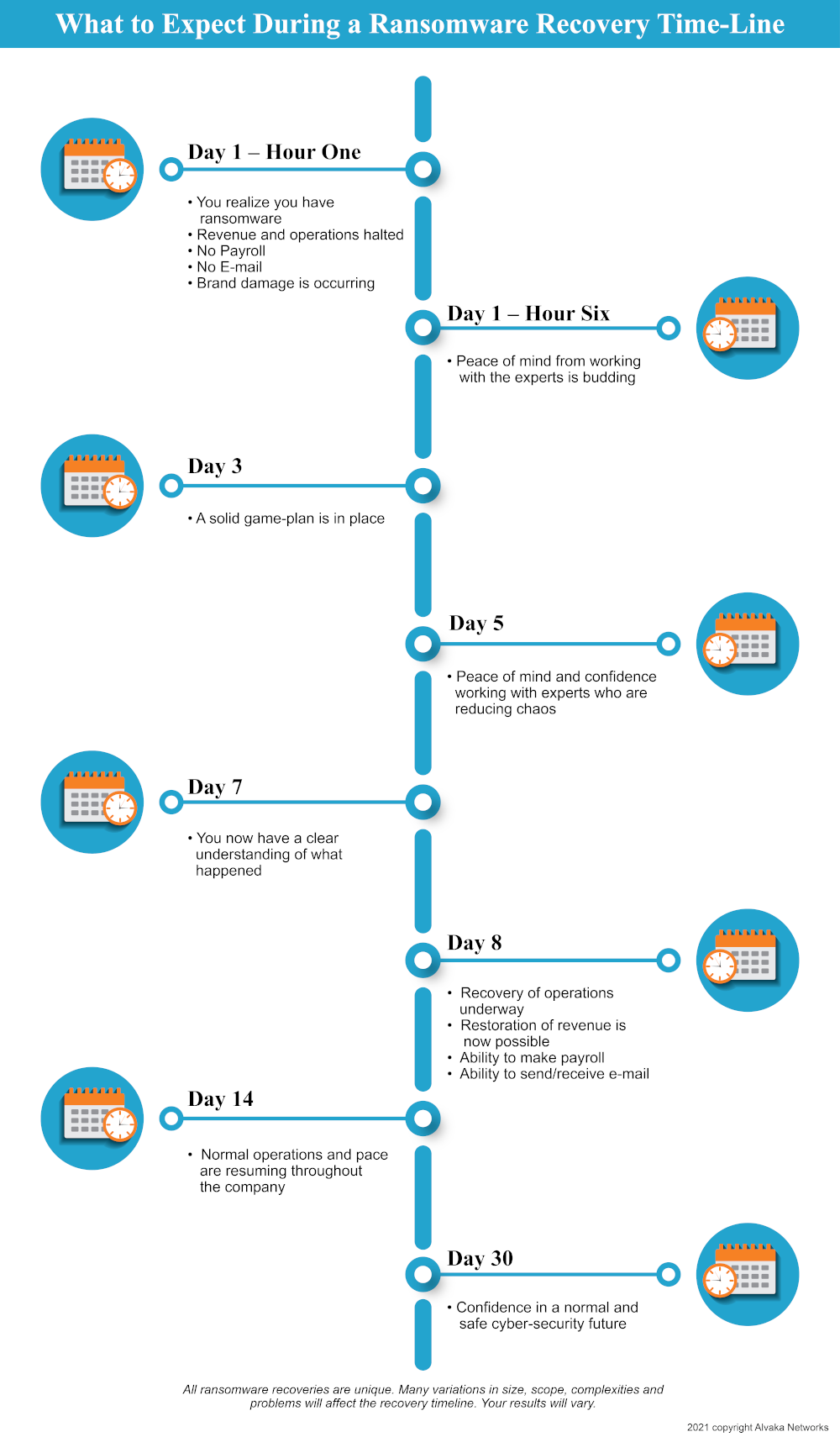
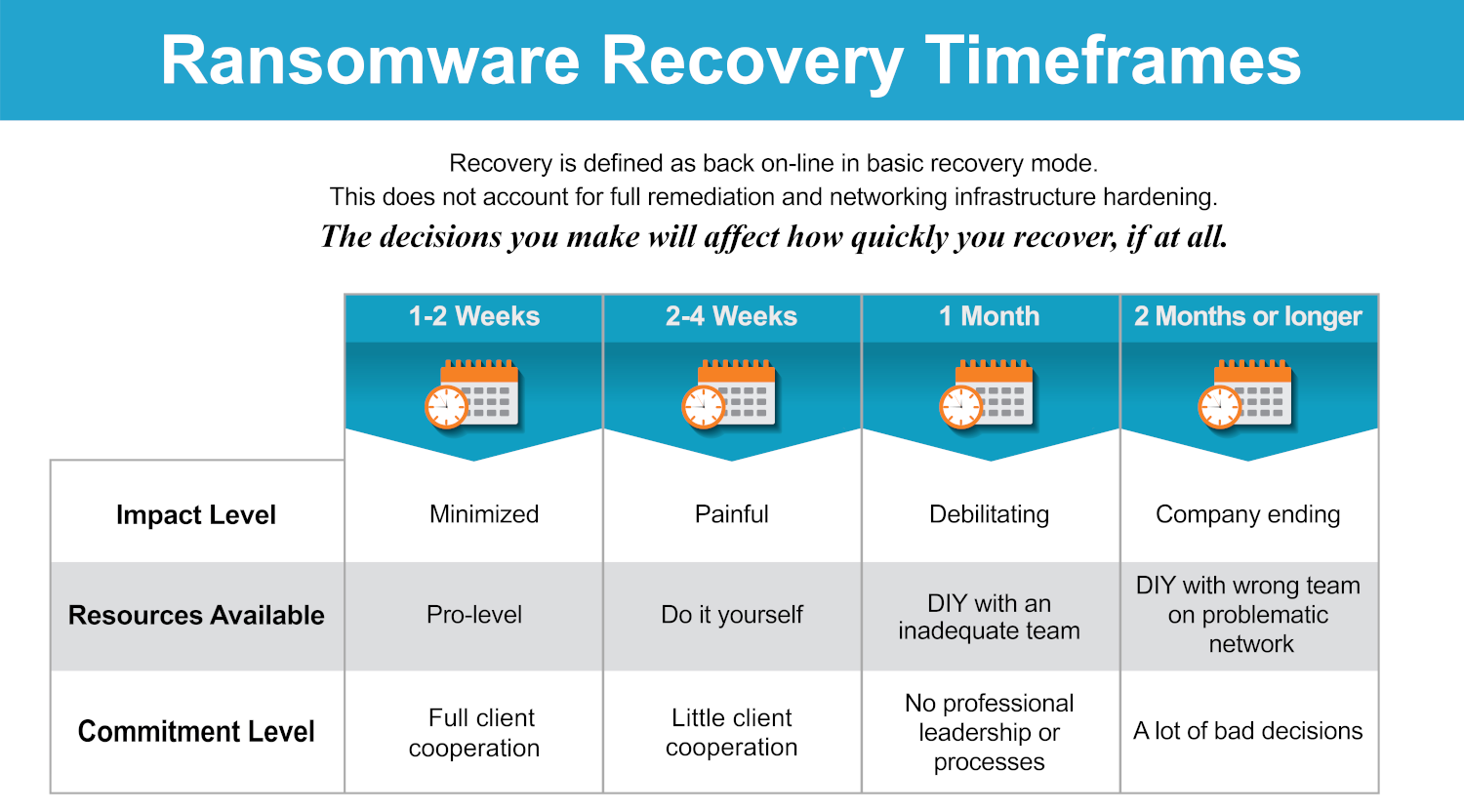
The time it takes to recover from a ransomware attack can vary widely. For most companies who are unprepared and unexperienced, recovery efforts will typically fall between the two to four week mark. However, recovery time can be cut in half (about one to two weeks) if you have a well-managed effort and experienced team.
Prolonged recovery efforts are a result of many factors, and often come at the expense of the company’s bottom line and reputation. In some cases, the company may never recover. It is therefore crucial to consider all of the variables that can impact the time it takes to recover from an attack. Below are five variables we find to have the most influence.
1. The most important is having a well-coordinated and experienced team of experts (includes ransomware recovery team, insurance company, incident response team, lawyers, ransomware negotiator, etc.) 2. Type of ransomware and the experience level of the attackers. 3. Size of your IT infrastructure. 4. Configuration of your It infrastructure before the attack. 5. The experience level, maturity, and size of your IT team.
3. How much will it cost to recover from a ransomware attack?
If your company has been hit with ransomware, you might be wondering how much the incident will cost you. There are many variables that will determine your costs, including company size, the complexity of your network and applications, and which ransomware you have been infected with. There are two cost categories to consider: Cost to Recover and Total Cost of Ransomware Recovery (TCRR).
The Cost to Recover includes the amount of cash you will need to pay out for recovery activities like incident response, decryption and system recovery, forensics, and the ransom amount paid (if any). The Total Cost of Ransomware Recovery (TCRR) will also include the lost revenue associated with the incident, due to downtime, brand reputation, etc. Your downtime will vary depending on the specifics of your attack.
We have created a Ransomware Recovery Cost Calculator that will help you determine your estimated TCRR.
skip render: ucaddon_creative_buttons
4. If I pay the ransomware demand, will I get my data back?
With any ransomware incident, you are dealing with criminals who will not hesitate to harm you further to receive payment out of you.
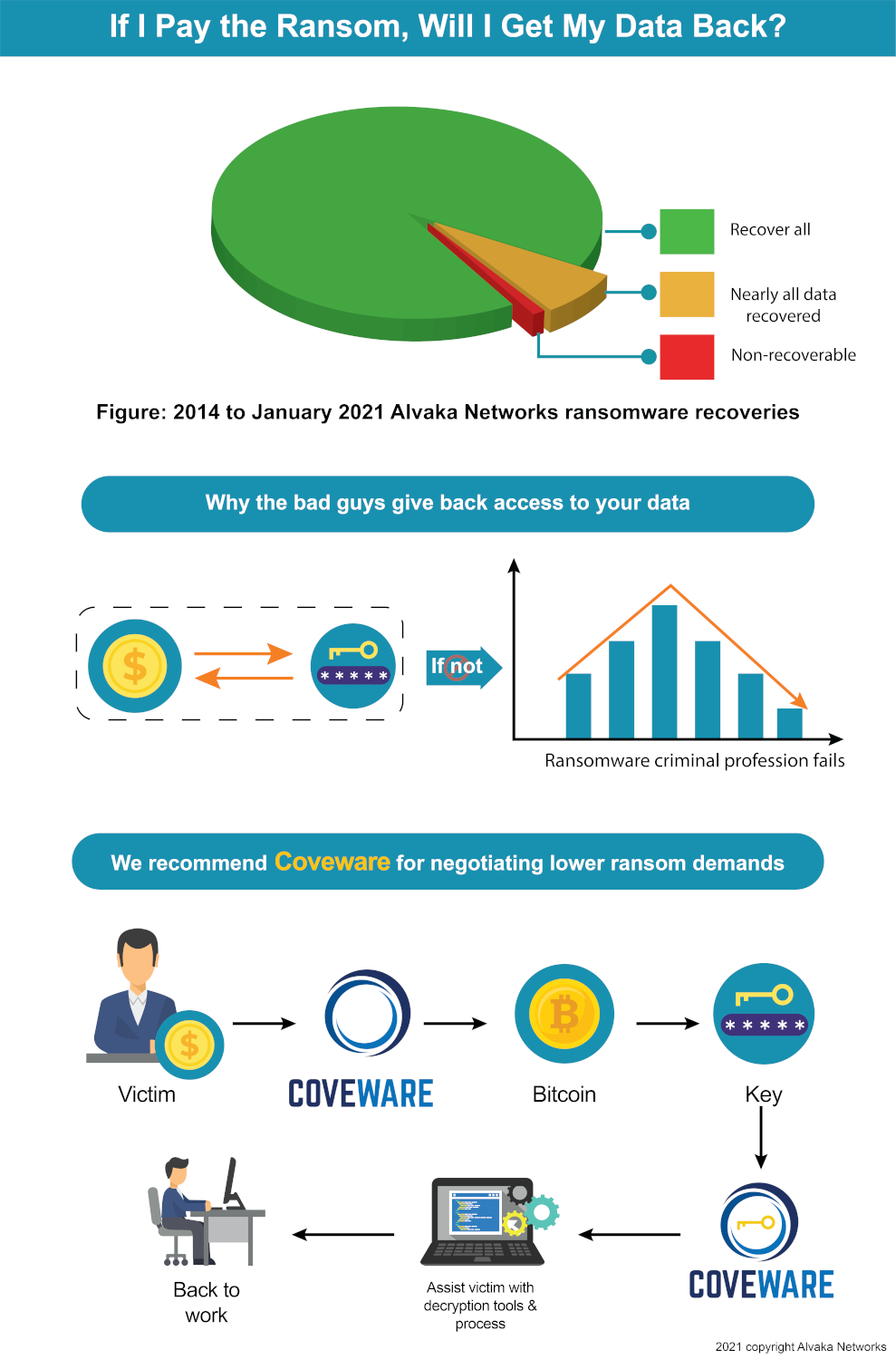
Additionally, the odds aren’t in your favor if your backups are outdated – like most ransomware victims. So, you are wondering, should I trust the word of these cybercriminals? No, you shouldn’t. However, these threat actors have a reputation they must maintain. If the cybercriminal industry is known for having individuals that don’t provide a decryption key when paid, well, then their leverage factor gets significantly reduced. No one would pay a ransom knowing that the most likely scenario will be they get scammed. These cybercriminals are making too much money, and they wouldn’t risk ruining that. Now, that doesn’t mean there have been zero instances where a cybercriminal didn’t provide a decryption key. Therefore, if you decide to pay a ransom, we recommend Coveware for the negotiation process.
5. How much is the average ransomware demand?
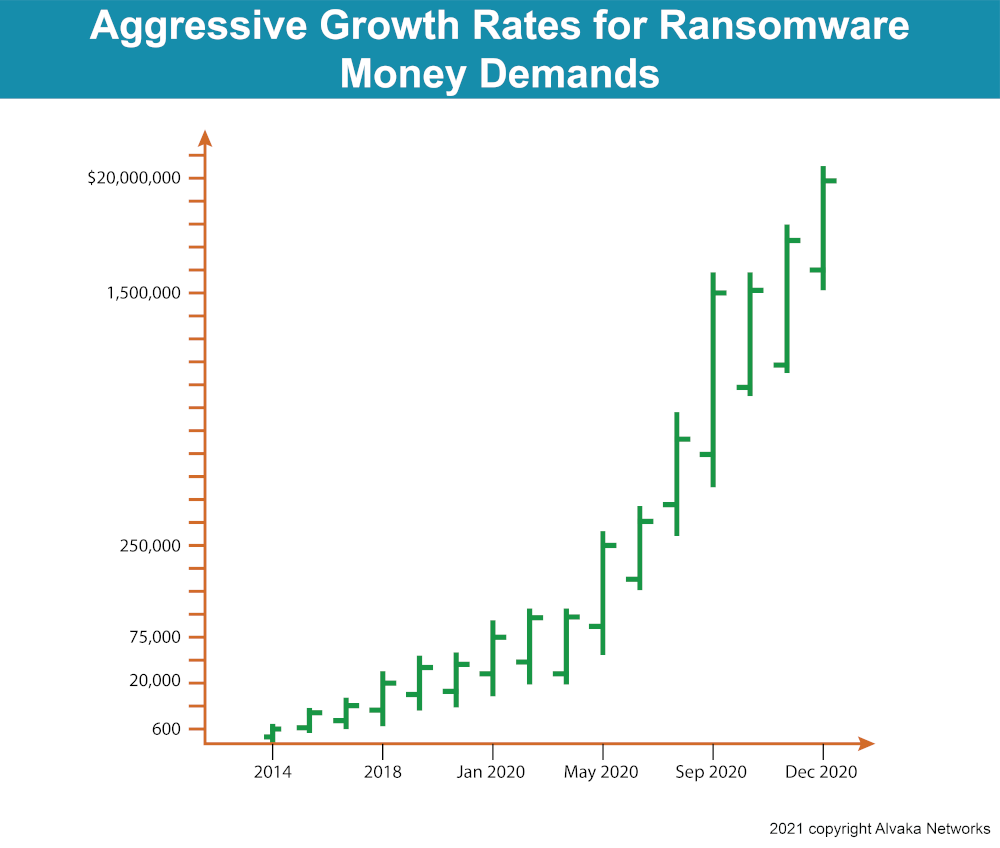
Each ransom attack can vary significantly, so it quite difficult to pinpoint the exact amount of a typically demanded in ransomware cases. However, history shows a clear trend – an increasing ransom amount. In the early years, a $200M per year company would only expect a ransom of a few hundred dollars.
By 2018, threat actors became more efficient and created in-depth plans, allowing them to price a ransom proportionally with a company’s size. In 2020, a typical ransom for a company producing $20M annually would receive a ransom amount of $50-100k. By the end of the year, ransoms were pushing themselves into the millions, and in November, we saw our first $20M ransom.
Overall, the ransom amount depends on many factors, like what tools the threat actors are using, number of servers, number of files, total storage, and more. Additionally, according to a report by Coveware, ransom payments are increasing (see Ransomware will likely get worse in 2021), and findings show that the typical ransom amount has risen 31% to $233,817, as of late 2020.
6. Who are the best ransomware recovery service companies?
Alvaka has been involved in many recovery efforts and have first-hand experience working with companies that offer specific services when it comes to recovering from ransomware. The ransomware recovery process is complex and will require building a response team specific to your ransomware incident in order to be successful in your efforts.
Ransomware recovery service companies fall into three primary categories:
Ransomware negotiation/decryption
Incident response/containment
Ransomware recovery/IT system rebuilding and recovery
It is unlikely you will find one ransomware recovery service company that offers the full stack of recovery services you need, so you will need to determine what you need and choose accordingly. Here are our recommendations for the Best Ransomware Recovery Services Companies.
7. Should I engage a lawyer after a cyber attack? Who are the best ransomware lawyers and cyber breach coaches?
Another crucial addition to your ransomware recovery response team should include a ransomware or cyber breach lawyer, usually specializing in ransomware, data exfiltration and phishing related business email compromise. They will be your trusted advisor throughout your ransomware and cyber breach recovery journey. A ransomware attack does not just cause a dire technical and business issue, but in many cases it can be a legal issue as well.
A ransomware and cyber breach lawyer will:
engage and manage all parties involved in the recovery process
provide important legal protections via attorney client privilege
ensure compliance with the law
help minimize and manage aftermath of a data compromise
Ransomware attacks are becoming increasingly common, and whether you are a small, medium, or large company, you are a target.
If you have been an unfortunate victim of a ransomware attack, you are likely overwhelmed and wondering what the next steps are. We have been involved in many recovery efforts and have outlined what our clients experience as the most common and important steps when recovering from a ransomware attack.
The process will be lengthy, expensive, and stressful but putting together a well-rounded recovery and response team will be invaluable. In the initial stages, engage a lawyer and find out what insurance covers. Have your response team assess the current situation (identify type of ransomware and damages) and start collecting forensic data. Decide if you will pay the ransom and/or if you will hire a negotiator that specializes in ransomware. Keep the attack confidential while you lay out your plan…continue to review the plan with your team…and then execute with vigor. You will then need to develop and implement a cybersecurity strategy moving forward and make this a consistent part of your overall business strategy.
The time it takes to recover from a ransomware attack can vary widely. For most companies who are unprepared and unexperienced, recovery efforts will typically fall between the two to four week mark. However, recovery time can be cut in half (about one to two weeks) if you have a well-managed effort and experienced team.
Prolonged recovery efforts are a result of many factors, and often come at the expense of the company’s bottom line and reputation. In some cases, the company may never recover. It is therefore crucial to consider all of the variables that can impact the time it takes to recover from an attack. Below are five variables we find to have the most influence.
1. The most important is having a well-coordinated and experienced team of experts (includes ransomware recovery team, insurance company, incident response team, lawyers, ransomware negotiator, etc.) 2. Type of ransomware and the experience level of the attackers. 3. Size of your IT infrastructure. 4. Configuration of your It infrastructure before the attack. 5. The experience level, maturity, and size of your IT team.
If your company has been hit with ransomware, you might be wondering how much the incident will cost you. There are many variables that will determine your costs, including company size, the complexity of your network and applications, and which ransomware you have been infected with. There are two cost categories to consider: Cost to Recover and Total Cost of Ransomware Recovery (TCRR).
The Cost to Recover includes the amount of cash you will need to pay out for recovery activities like incident response, decryption and system recovery, forensics, and the ransom amount paid (if any). The Total Cost of Ransomware Recovery (TCRR) will also include the lost revenue associated with the incident, due to downtime, brand reputation, etc. Your downtime will vary depending on the specifics of your attack.
We have created a Ransomware Recovery Cost Calculator that will help you determine your estimated TCRR.
skip render: ucaddon_creative_buttons
With any ransomware incident, you are dealing with criminals who will not hesitate to harm you further to receive payment out of you.
Additionally, the odds aren’t in your favor if your backups are outdated – like most ransomware victims. So, you are wondering, should I trust the word of these cybercriminals? No, you shouldn’t. However, these threat actors have a reputation they must maintain. If the cybercriminal industry is known for having individuals that don’t provide a decryption key when paid, well, then their leverage factor gets significantly reduced. No one would pay a ransom knowing that the most likely scenario will be they get scammed. These cybercriminals are making too much money, and they wouldn’t risk ruining that. Now, that doesn’t mean there have been zero instances where a cybercriminal didn’t provide a decryption key. Therefore, if you decide to pay a ransom, we recommend Coveware for the negotiation process.
Each ransom attack can vary significantly, so it quite difficult to pinpoint the exact amount of a typically demanded in ransomware cases. However, history shows a clear trend – an increasing ransom amount. In the early years, a $200M per year company would only expect a ransom of a few hundred dollars.
By 2018, threat actors became more efficient and created in-depth plans, allowing them to price a ransom proportionally with a company’s size. In 2020, a typical ransom for a company producing $20M annually would receive a ransom amount of $50-100k. By the end of the year, ransoms were pushing themselves into the millions, and in November, we saw our first $20M ransom.
Overall, the ransom amount depends on many factors, like what tools the threat actors are using, number of servers, number of files, total storage, and more. Additionally, according to a report by Coveware, ransom payments are increasing (see Ransomware will likely get worse in 2021), and findings show that the typical ransom amount has risen 31% to $233,817, as of late 2020.
Alvaka has been involved in many recovery efforts and have first-hand experience working with companies that offer specific services when it comes to recovering from ransomware. The ransomware recovery process is complex and will require building a response team specific to your ransomware incident in order to be successful in your efforts.
Ransomware recovery service companies fall into three primary categories:
Ransomware negotiation/decryption
Incident response/containment
Ransomware recovery/IT system rebuilding and recovery
It is unlikely you will find one ransomware recovery service company that offers the full stack of recovery services you need, so you will need to determine what you need and choose accordingly. Here are our recommendations for the Best Ransomware Recovery Services Companies.
Another crucial addition to your ransomware recovery response team should include a ransomware or cyber breach lawyer, usually specializing in ransomware, data exfiltration and phishing related business email compromise. They will be your trusted advisor throughout your ransomware and cyber breach recovery journey. A ransomware attack does not just cause a dire technical and business issue, but in many cases it can be a legal issue as well.
A ransomware and cyber breach lawyer will:
engage and manage all parties involved in the recovery process
provide important legal protections via attorney client privilege
ensure compliance with the law
help minimize and manage aftermath of a data compromise
Each year, more sophisticated and harder-to-detect ransomware variants are developed and deployed onto unsuspecting companies. Having access to valuable and reliable ransomware resources and information can make all the difference.
When you’ve become a victim of ransomware, the crucial first step to recovery is to identify which variant the threat actors used. From there, the experience and knowledge of a professional ransomware removal team can be very beneficial.
There are many free, easy, and reliable ways to identify which ransomware variant has infected you. Once identification of the ransomware variant is successful, the recovery process via the deployment of an effective plan can begin. The specifics of each incident and what they require will vary from case to case, but you can generally expect common essential steps in a recovery effort.
How do I prepare in advance to reduce the risk of ransomware and other cyber attacks?
As a network security provider, we have seen first-hand what the long and painful road to ransomware recovery can involve. The recovery process can take months and carry significant costs beyond insurance coverage and ransom demand. Fortunately, you can take steps to reduce your chances of becoming a victim.
Implement the below actions to reduce the risk of ransomware and other cyber attacks:
• Require multi-factor authentication
• Patch ALL systems frequently
• Manage or Remove Deprecated or End-Of-Life systems
• Update Firewalls and other firmware
• Enable strong spam (email) filters
• Implement user training and simulated attacks
• Filter network traffic
• Implement URL reputation services
• Limit access to data and other assets. Segment your network!
• Restrict remote systems access
• Use active scan antivirus/antimalware
• Remove all local admin rights and restrict non-IT staff rights
• If you can, BLOCK (and if not, Disable) Office macros
• Implement a backup system that covers all critical data and system states. Isolate backups from the network; institute insider protections; store offline image templates, license keys, source code and copies of executables
• Get breach insurance that covers ransomware
• Ensure your exception-based monitoring can immediately trigger alerts
• Create a Business Continuity Plan (BCP) for security events
Should I Buy Cyber Breach Insurance? And Why?
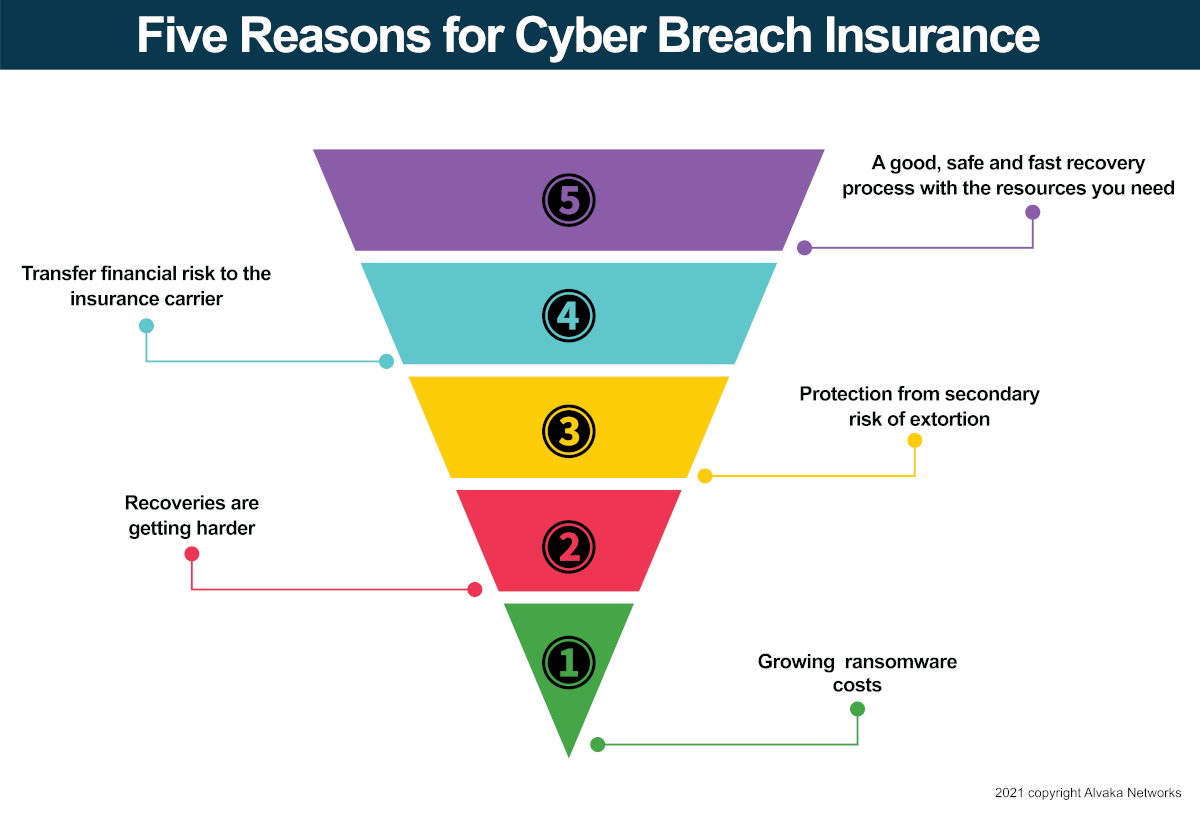
Cyber breach insurance has grown to be a valuable asset over the last few years due to constantly changing trends in cybersecurity and threat actor tactics. So, should you invest in cyber breach insurance in 2021? Yes, and we’ll list out the top 5 reasons why you should.
1. The trends are against you. Each year, threat actors become more efficient and smarter in proportionally pricing a ransom to your company’s size. In the early years, a typical ransom would have cost only a few hundred dollars, but now threat actors can accurately estimate your revenue and price accordingly.
2. Unfortunately, it is harder to recover from ransomware than before. In 2018, a nasty habit among threat actors developed – deletion of backups. Now, you can expect cybercriminals to learn everything about your network, attack with a plan, delete backups, and encrypt all your data.
3. Not only will they delete and encrypt files, but they will also attempt to extort you by threatening to sell your confidential information.
4. This one is obvious. The transfer of risk to the insurance carrier. Also, ensure your cyber breach insurance covers the ransom, forensic, ransom negotiation, legal representation, ransomware recovery, public relations, fines and breach notification, and business interruption.
5. Following a sound ransomware recovery process with adequate resources is key.
skip render: ucaddon_creative_buttons
How much cyber breach insurance do I need?
When it comes to cybersecurity threats and the potential losses, business decision makers might be wondering just how much cyber breach insurance coverage they need. A simple answer to this, given averages and trends, is that your coverage should range from at least $1,000,000 to $5,000,000. Additionally, you will want to make sure your total limit is around 10% to 20% of your annual revenue to cover business interruption losses.
A more analytical process to determine what your coverage should be is to estimate how much a cyber incident, like ransomware, is likely to cost you if your company were attacked. Getting hit with ransomware is certainly not the only reason you would need cyber breach coverage, however, we recommend using a ransomware breach as the best indicator for how much coverage you should buy due to the following…
Ransomware is the most prevalent cyber breach incident, with significant cost implications
Ransomware attacks commonly include an extortion demand, with bad actors threatening to release data that was exfiltrated from the victims’ network
Ransomware attack cost components include every expense category involved in a cyber breach event, including legal counsel, incident response, digital forensics, ransom negotiation, and more
To estimate your cost of a ransomware attack, you can use our Ransomware Recovery Cost Calculator below. The calculator calculates in real time and we encourage you to play with some differing values in some “what if” type situations.
skip render: ucaddon_creative_buttons
Each year, more sophisticated and harder-to-detect ransomware variants are developed and deployed onto unsuspecting companies. Having access to valuable and reliable ransomware resources and information can make all the difference.
When you’ve become a victim of ransomware, the crucial first step to recovery is to identify which variant the threat actors used. From there, the experience and knowledge of a professional ransomware removal team can be very beneficial.
There are many free, easy, and reliable ways to identify which ransomware variant has infected you. Once identification of the ransomware variant is successful, the recovery process via the deployment of an effective plan can begin. The specifics of each incident and what they require will vary from case to case, but you can generally expect common essential steps in a recovery effort.
As a network security provider, we have seen first-hand what the long and painful road to ransomware recovery can involve. The recovery process can take months and carry significant costs beyond insurance coverage and ransom demand. Fortunately, you can take steps to reduce your chances of becoming a victim.
Implement the below actions to reduce the risk of ransomware and other cyber attacks:
• Require multi-factor authentication
• Patch ALL systems frequently
• Manage or Remove Deprecated or End-Of-Life systems
• Update Firewalls and other firmware
• Enable strong spam (email) filters
• Implement user training and simulated attacks
• Filter network traffic
• Implement URL reputation services
• Limit access to data and other assets. Segment your network!
• Restrict remote systems access
• Use active scan antivirus/antimalware
• Remove all local admin rights and restrict non-IT staff rights
• If you can, BLOCK (and if not, Disable) Office macros
• Implement a backup system that covers all critical data and system states. Isolate backups from the network; institute insider protections; store offline image templates, license keys, source code and copies of executables
• Get breach insurance that covers ransomware
• Ensure your exception-based monitoring can immediately trigger alerts
• Create a Business Continuity Plan (BCP) for security events
Cyber breach insurance has grown to be a valuable asset over the last few years due to constantly changing trends in cybersecurity and threat actor tactics. So, should you invest in cyber breach insurance in 2021? Yes, and we’ll list out the top 5 reasons why you should.
1. The trends are against you. Each year, threat actors become more efficient and smarter in proportionally pricing a ransom to your company’s size. In the early years, a typical ransom would have cost only a few hundred dollars, but now threat actors can accurately estimate your revenue and price accordingly.
2. Unfortunately, it is harder to recover from ransomware than before. In 2018, a nasty habit among threat actors developed – deletion of backups. Now, you can expect cybercriminals to learn everything about your network, attack with a plan, delete backups, and encrypt all your data.
3. Not only will they delete and encrypt files, but they will also attempt to extort you by threatening to sell your confidential information.
4. This one is obvious. The transfer of risk to the insurance carrier. Also, ensure your cyber breach insurance covers the ransom, forensic, ransom negotiation, legal representation, ransomware recovery, public relations, fines and breach notification, and business interruption.
5. Following a sound ransomware recovery process with adequate resources is key.
skip render: ucaddon_creative_buttons
When it comes to cybersecurity threats and the potential losses, business decision makers might be wondering just how much cyber breach insurance coverage they need. A simple answer to this, given averages and trends, is that your coverage should range from at least $1,000,000 to $5,000,000. Additionally, you will want to make sure your total limit is around 10% to 20% of your annual revenue to cover business interruption losses.
A more analytical process to determine what your coverage should be is to estimate how much a cyber incident, like ransomware, is likely to cost you if your company were attacked. Getting hit with ransomware is certainly not the only reason you would need cyber breach coverage, however, we recommend using a ransomware breach as the best indicator for how much coverage you should buy due to the following…
Ransomware is the most prevalent cyber breach incident, with significant cost implications
Ransomware attacks commonly include an extortion demand, with bad actors threatening to release data that was exfiltrated from the victims’ network
Ransomware attack cost components include every expense category involved in a cyber breach event, including legal counsel, incident response, digital forensics, ransom negotiation, and more
To estimate your cost of a ransomware attack, you can use our Ransomware Recovery Cost Calculator below. The calculator calculates in real time and we encourage you to play with some differing values in some “what if” type situations.
Stop being a victim of Ransomware and take action today!
Maybe you think that you’re not in any danger and that you take all the necessary precautions. Maybe you believe that you’ve educated your employees enough on the risks of random downloads, clicking on unsecured links, and opening strange emails.
RobbinHood Ransomware Data Recovery Services
Being a victim of ransomware is draining to the performance, finances, and growth of a company. If you ever fall under the unfortunate circumstances of being a victim, immediately seek professional help to resolve the issue. At Alvaka, our team of professionals is equipped with the skill and resources to deal with all variants of ransomware: including RobbinHood. Time is of the essence when it comes to a potential or existing network compromise, and you can count on Alvaka to swiftly recover your business.
What Exactly Is RobbinHood Ransomware?
RobbinHood Ransomware is a variant of ransomware that is, like other common variants, “human-operated,” and “typically start with an RDP brute-force attack against an exposed asset” (Microsoft). An RDP brute-force attack is when a hacker uses an automated tool that tries numerous combinations of usernames and passwords to gain access into the target’s computer. Eventually, the cybercriminal gains access and then uses that account’s information to, “obtain privileged credentials, mostly local administrator accounts with shared or common passwords, and service accounts with domain admin privileges” (Microsoft). Once they have gathered up enough accounts, they leave behind local accounts in the Active Directory to easily gain access at another time.
What You Can Expect from Alvaka
Paying a ransom never guarantees a cybercriminal will give you access to the files they have encrypted. Additionally, paying gives the attacker an incentive to come back later. At Alvaka, we recommend you seek qualified assistance to handle the recovery of your network. Our staff is ready 24×7×365 to deliver quality assistance in any malicious IT event. We take the extra steps to ensure that your network is eradicated of any weaknesses that could lead to any future complications.
Alvaka RobbinHood Ransomware Recovery Services are designed to help companies recover from ransomware attacks and protect your systems from future attacks.
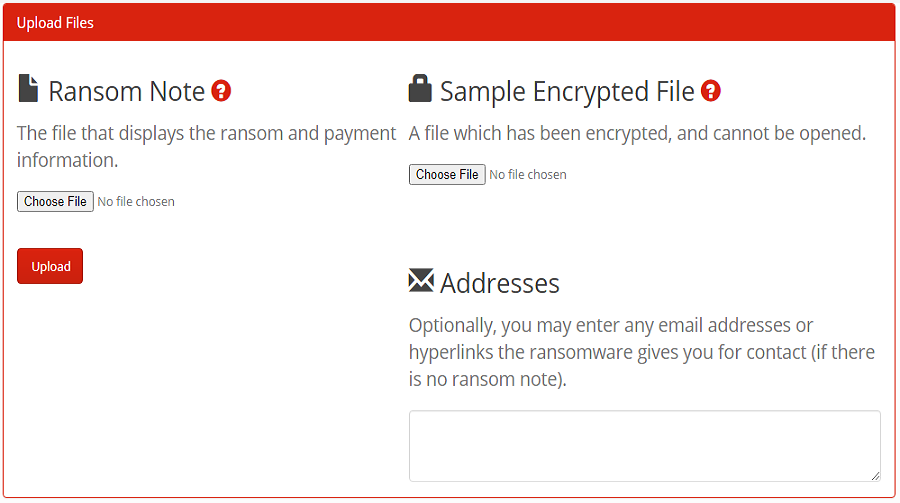
Is there a REvil decryption key available? YES Search the No More Ransomware Decryption Toolswebpage to find the decryptor for the ransomware you’ve been hit with.
REvil Ransomware Recovery Services
Business downtime resulting from a network breach can be devastating to a company’s productivity and revenue. Priority should be placed on swiftly bringing the business back up and running, or else it could face possible bankruptcy. With Alvaka, your priority to recover becomes ours. Our determined and talented staff is ready 24×7×365 to defend and combat numerous varieties of ransomware attacks, including REvil.
What is REvil Ransomware?
REvil, also called Sodinokibi, is a variant of ransomware that exploits vulnerabilities in network devices in Pulse VPN. Cybercriminals use the vulnerabilities to obtain administrative credentials to access networks and steal the documents of customers, and any other possible data they can retrieve. The stolen data then gets uploaded to a site called “Happy Blog” and “the ransomware gang uses the site to post samples of the stolen data and then threaten to release the actual files” (BleepingComputer). REvil operators use techniques that are similar to other variants of ransomware. Tools such as Mimikatz and PsExec are used to laterally spread within a network and perform reconnaissance to check which servers and workstations are exposed.
What You Can Expect from Alvaka
You must reach out for professional help immediately after being attacked by ransomware. The faster you react, the better your chances of being able to recover most, if not all, of your data. Surrendering your assets via payment of a ransom only gives an incentive for cybercriminals to attack again. You can expect our staff at Alvaka to work effectively to purge your network, servers, and workstations of all traces of ransomware. We also scan for possible weaknesses to prevent future ransomware events from occurring. If your business has been hit by ransomware, do not hesitate to give us a call.https://www.youtube.com/watch?v=AK8lfAzQmkg&source_ve_path=OTY3MTQ&embeds_referring_euri=https%3A%2F%2Fwww.alvaka.net%2FAlvaka REvil Ransomware Recovery Services are designed to help companies recover from ransomware attacks and protect your systems from future attacks.
Stop being a victim of Ransomware and take action today! Maybe you think that you’re not in any danger and that you take all the necessary precautions. Maybe you believe that you’ve educated your employees enough on the risks of random downloads, clicking on unsecured links, and opening strange emails.
PonyFinal Ransomware Recovery Services
Being an unfortunate victim of ransomware can have devastating effects on the financial condition, growth, and performance of a company. One should always seek immediate professional help if a ransomware situation were to arise. Fortunately, Alvaka offers an exceptional team of professionals equipped with the resources and skills to deal with many types of ransomware incidents – including PonyFinal. Time is a crucial component of our work method, and you can count on us to quickly recover your business.
What is PonyFinal Ransomware?
PonyFinal Ransomware is a type of ransomware that is Java-based. Usually, it is considered a novelty but the campaign methods used by cybercriminals are very common and destructive. In order for cybercriminals to “establish persistence, they [use] PowerShell commands to launch the system tool mshta.exe and set up a reverse shell based on the common PowerShell attack framework.” Additionally, they use other cyber tools, such as Splashtop, to keep remote desktop connections open to systems with administrative access privileges.
What to Expect from Your PonyFinal Ransomware Removal Company
At Alvaka, you can expect us to provide your company with a highly qualified staff that is ready to respond to your needs 24×7×365. Paying a ransomware never guarantees that you will get your data back, but it will certainly give cybercriminals an incentive to strike again. We suggest your first step to battling ransomware is contacting a professional team, and if you find yourself a victim of ransomware, do not hesitate to give us a call.https://www.youtube.com/watch?v=AK8lfAzQmkg&source_ve_path=OTY3MTQ&embeds_referring_euri=https%3A%2F%2Fwww.alvaka.net%2FAlvaka’s PonyFinal Ransomware Recovery Services are designed to help companies recover from ransomware attacks and protect systems from future attacks.
Stop being a victim of Ransomware and take action today!
Maybe you think that you’re not in any danger and that you take all the necessary precautions. Maybe you believe that you’ve educated your employees enough on the risks of random downloads, clicking on unsecured links, and opening strange emails.
NetWalker Ransomware Prevention Services
During a ransomware network breach, your first step should be to seek professional assistance. It is important to note that business downtime will produce disastrous results when not dealt with immediately. With Alvaka, our highly skilled and resourceful team is ready to combat and defend against potential or existing ransomware events. Our expertise in numerous types of ransomware, including NetWalker, allows us to be properly equipped to recover your business.
What Is NetWalker Ransomware?
NetWalker ransomware is a new campaign started by cybercriminals to infect hospitals and other healthcare networks by utilizing emails that appear to contain information about coronavirus (Covid-19). The email contains a .vbs attachment that “contains an embedded NetWalker Ransomware executable and obfuscated code to extract and launch it on the computer” (BleepingComputer). Alternatively, they also use misconfigured IIS-based applications to gather credentials. Although the NetWalker campaign is new, these strategies deployed by cybercriminals are already known.
Victims will know when they have been infiltrated as notice will be left behind for them to see. The notice will include information and instructions on how to obtain cryptocurrency in order to pay the requested ransom.
What You Can Expect from Alvaka
If you ever find yourself a victim of ransomware, we suggest you immediately seek professional help. Paying the ransom should be your last option, and it is important to remember that paying will not guarantee full, or any, data recovery. With Alvaka, you can expect our highly-skilled, determined, and responsive team to work diligently to recover your computer environments, stations and servers.
Alvaka’s NetWalker Ransomware Recovery Services are designed to help companies recover from ransomware attacks and protect their systems from future attacks.
Stop being a victim of Ransomware and take action today! Maybe you think that you’re not in any danger and that you take all the necessary precautions. Maybe you believe that you’ve educated your employees enough on the risks of random downloads, clicking on unsecured links, and opening strange emails.
AKO Ransomware Data Recovery Services
With downtime severely impacting company performance in all sectors, you can depend on Alvaka to make your data recovery our top priority. Our well-equipped team of professionals have helped countless businesses recover from ransomware: including AKO attacks.
What is AKO?
AKO is a variant type of ransomware that can be separated into two categories. The difference between the two lies within the way that the victims are meant to make contact with the hacker and/or pay a ransom. When you’re the victim of an AKO attack of any nature, a ransom note is created as a text file that will show like this: ako-readme.txt. In one version, you will be directed to pay the ransom via a Tor site. In the other, there will be instructions to send an email to the cybercriminals. Both types of AKO will generate an id.key, dropping it into your folders that have encrypted files and renaming them all.
AKO Ransomware Recovery Consulting Services by Alvaka
With Alvaka, you’ll have a highly qualified team ready to immediately begin recovering your information. We also investigate the cause of your attack and implement the proper techniques so you don’t become a victim again. We recommend that you do not pay the ransom since it is not going to guarantee that the criminals will give you back your files.https://www.youtube.com/watch?v=AK8lfAzQmkgAlvaka Cybersecurity Solutions are designed to protect your company’s systems from Ransomware and help you recovery when necessary.